
 Our Editorial Team







How We Ranked These Precious Metals IRA Companies
Our rankings reflect a weighted scoring model applied to 18 precious metals IRA companies between January and February 2026, with hands-on evaluation of the onboarding process at each provider.
We personally opened accounts, requested gold IRA kits, and timed the onboarding workflow at 20+ companies. Each company received a composite score based on seven weighted criteria.
Scoring Criteria and Weights
- Fee Transparency (25%) — We compared setup fees ($50–$300), annual custodian fees ($75–$300), and storage fees ($100–$300/yr). Companies that published all fees upfront scored highest.
- Depository Network & Storage Options (15%) — We verified IRS-approved depository partnerships (Delaware Depository, Brinks Global Services) and whether segregated storage was available.
- BBB Rating & Complaint Resolution (15%) — We checked Better Business Bureau ratings, complaint volume, and resolution speed over the past 3 years.
- IRS Compliance Track Record (15%) — We reviewed each company's history of IRS Form 5498 reporting accuracy and adherence to IRC 408(m)(3)(B) purity requirements.
- Customer Onboarding Speed (10%) — We measured days from initial contact to funded account, including 401(k) rollover processing time.
- Minimum Investment vs. Market Average (10%) — The market average minimum is $25,000. Companies offering lower minimums without sacrificing service scored higher.
- Education Quality & No-Pressure Sales (10%) — We evaluated gold IRA kit quality, one-on-one consultations, and whether representatives used high-pressure tactics.
Companies that scored below 3.0 out of 5.0 on any single criterion were excluded from our final rankings. The five companies listed on this page represent the top performers from our initial longlist of 18.
What Is a Precious Metals IRA? (Self-Directed IRA for Physical Metals)
A precious metals IRA is a self-directed Individual Retirement Account that holds IRS-approved physical gold, silver, platinum, or palladium instead of paper assets like stocks and bonds.
Under IRC Section 408(m)(3)(B), the IRS permits specific bullion and coins inside an IRA provided they meet minimum purity standards: gold must be 99.5% pure (.995 fineness), silver 99.9%, and platinum and palladium 99.95%. The purity rules are reaffirmed in IRS Publication 590-A (2025), page 8. The American Gold Eagle is the one exception — Congress explicitly authorized it for IRA inclusion despite its 91.67% gold content.
Precious metals IRA companies route your account through a self-directed IRA custodian — Equity Trust Company, STRATA Trust, or Kingdom Trust — which administers the account and specializes in alternative assets including precious metals, real estate, and private equity. Unlike mainstream brokerages such as Fidelity or Schwab, these custodians hold legal title to IRA-owned physical metals.
The custodian handles IRS reporting (Form 5498 annually), holds legal title to the metals on your behalf, and coordinates with an IRS-approved depository for physical storage. You direct the investment decisions — which metals to buy, when to sell — while the custodian ensures compliance.
Bullion vs. Numismatic Coins
Precious metals IRA companies sell only bullion-grade products because the IRS disqualifies numismatic coins, whose value depends on collectibility rather than metal content. The distinction matters financially: numismatic coins carry premiums of 20–100% over spot price, while LBMA Good Delivery and COMEX-approved bullion products typically trade at 2–8% over spot. Reputable precious metals IRA companies clearly disclose the spread markup on every purchase and refuse to place collector-grade pieces in IRA accounts.
Precious Metals IRA Fees: What You Will Actually Pay
Total first-year costs for a precious metals IRA range from $225 to $900 depending on the company, account size, and storage type. The four categories below — setup, custodian, storage, and dealer spread markup — each affect your net return and compound over time.
Setup Fees
Augusta Precious Metals, Goldco, and Birch Gold Group tie for the lowest setup fee at $50. American Hartford Gold waives setup entirely for accounts over $25,000. Noble Gold charges $80. Industry range is $50–$300 one-time — promotionally waived fees may revert in year two, so confirm in writing.
Annual Custodian Fees
Self-directed IRA custodians charge $75 to $300 per year for account administration, IRS reporting (Form 5498), and record-keeping. Equity Trust Company charges $75/year for accounts under $100,000 and $125/year above that threshold. STRATA Trust charges a flat $95/year. Kingdom Trust uses a tiered model starting at $100/year.
Storage Fees
IRS-approved depositories charge $100 to $300 per year for storage. Segregated storage — where your metals are stored separately and individually identified — costs more than commingled storage, where your metals are pooled with other investors' holdings. The Delaware Depository charges approximately $150/year for segregated storage on accounts under $100,000. Brinks Global Services offers comparable rates.
Dealer Premiums (Markup Over Spot)
When you purchase gold for your IRA, you pay the spot price plus a dealer premium. Premiums range from 2% to 8% above spot price depending on the product. Gold bars carry lower premiums (2–4%) than gold coins (4–8%). Always ask your dealer for the exact premium over spot before purchasing.
Sell-Back Spreads
When you liquidate metals, the dealer buys back at a price below spot. This bid-ask spread is typically 1–3% for gold bars and 2–5% for coins. Companies with a buyback guarantee (like Augusta) commit to repurchasing your metals at a competitive price, reducing your liquidation risk.
How to Roll Over a 401(k) or Existing IRA Into a Precious Metals IRA
A direct rollover is the safest way to move retirement funds into a precious metals IRA — the money transfers between custodians without you touching it, so there is no tax withholding and no 60-day deadline.
Direct Rollover (Recommended)
In a direct rollover, your existing 401(k) plan administrator or IRA custodian sends funds directly to your new self-directed IRA custodian. You never receive a check. This method triggers no taxes, no penalties, and no mandatory withholding. Most direct rollovers complete in 5 to 15 business days.
Steps: (1) Open a self-directed IRA with your chosen precious metals IRA company. (2) Complete the rollover authorization form provided by your new custodian. (3) Your new custodian contacts your old plan administrator to initiate the transfer. (4) Funds arrive in your self-directed IRA. (5) You direct your dealer to purchase IRS-approved metals. (6) Metals ship to an approved depository.
Indirect Rollover (60-Day Rule)
In an indirect rollover, you receive the funds personally. Your old plan administrator withholds 20% for federal taxes. You must deposit the full amount — including the 20% withheld — into your new IRA within 60 calendar days. If you miss the deadline, the IRS treats the distribution as taxable income, plus a 10% early withdrawal penalty if you are under 59½.
The IRS limits indirect rollovers to one per 12-month period across all your IRAs. For these reasons, we recommend a direct rollover for 401(k)-to-gold-IRA transfers in nearly every case.
Eligible Account Types
- Traditional 401(k) — rollover to traditional precious metals IRA (no tax event)
- Roth 401(k) — rollover to Roth self-directed IRA (no tax event)
- Traditional IRA — transfer to traditional self-directed IRA (no tax event)
- SEP IRA and SIMPLE IRA — eligible for rollover to a self-directed precious metals IRA; SIMPLE IRA requires a 2-year waiting period from first contribution
- Roth conversion — traditional self-directed IRA assets (including metals) may be converted to a Roth SDIRA; taxes owed on converted amount in conversion year
- 403(b) and 457(b) — eligible for direct rollover after separation from service
- TSP (Thrift Savings Plan) — eligible for direct rollover to self-directed IRA
Your precious metals IRA company handles most of the paperwork. Augusta Precious Metals assigns a dedicated account representative who coordinates the rollover with your old plan administrator, typically completing the process within 7 to 10 business days.

Precious Metals IRA Storage: Segregated vs. Commingled Options
Segregated storage is worth the extra $50–$100/year for most investors because you receive the exact same bars and coins you purchased when you take an in-kind distribution.
Segregated Storage
In segregated (or allocated) storage, your metals are stored separately from other investors' holdings, individually identified by serial number, weight, and type. When you take a distribution or sell, you receive your specific metals — not equivalent substitutes. The Delaware Depository and Brinks Global Services both offer segregated storage options for IRA accounts.
Commingled Storage
In commingled (or unallocated) storage, your metals are pooled with other investors' holdings of the same type and purity. You own a specific quantity but not specific bars or coins. When you take a distribution, the depository delivers metals matching your holdings in type and weight, but not necessarily the original items you purchased. Commingled storage costs less — typically $100–$150/year vs. $150–$250/year for segregated.
IRS-Approved Depositories
The IRS requires that precious metals IRA holdings be stored at an approved depository — not at home, not in a personal safe deposit box. The most widely used depositories are: Delaware Depository (Wilmington, DE), Brinks Global Services (multiple US locations), IDS of Texas (Dallas), and HSBC Bank USA (New York). All four are insured by Lloyd's of London all-risk policies, maintain Class III vault specifications, and accept LBMA Good Delivery and COMEX-approved bars. Segregated storage at any of these facilities ensures your specific serial-numbered items are returned on distribution.
Storing IRA metals at home — including through a "checkbook control" LLC IRA or home storage IRA scheme marketed as IRS-compliant — violates IRS rules and results in a deemed distribution. The entire value of the metals becomes taxable income in the year of the violation, plus a 10% penalty if you are under 59½. The Tax Court confirmed this in McNulty v. Commissioner, 157 T.C. No. 10 (2021), ruling that a self-directed IRA LLC arrangement used to store gold coins at the owner's home constituted a prohibited transaction. The IRS also addressed this directly in Advisory Opinion 2014-0002.
IRS Rules for Precious Metals IRAs: Purity, Eligible Coins & Prohibited Transactions
The IRS imposes strict purity requirements, bans numismatic coins, and defines prohibited transactions that can disqualify your entire IRA — understanding these rules protects your retirement savings from costly penalties.
Purity Requirements Under IRC 408(m)(3)(B)
- Gold: minimum 99.5% purity (.995 fineness) — exception: American Gold Eagle (91.67%)
- Silver: minimum 99.9% purity (.999 fineness)
- Platinum: minimum 99.95% purity (.9995 fineness)
- Palladium: minimum 99.95% purity (.9995 fineness)
IRA-Eligible Coins and Bars
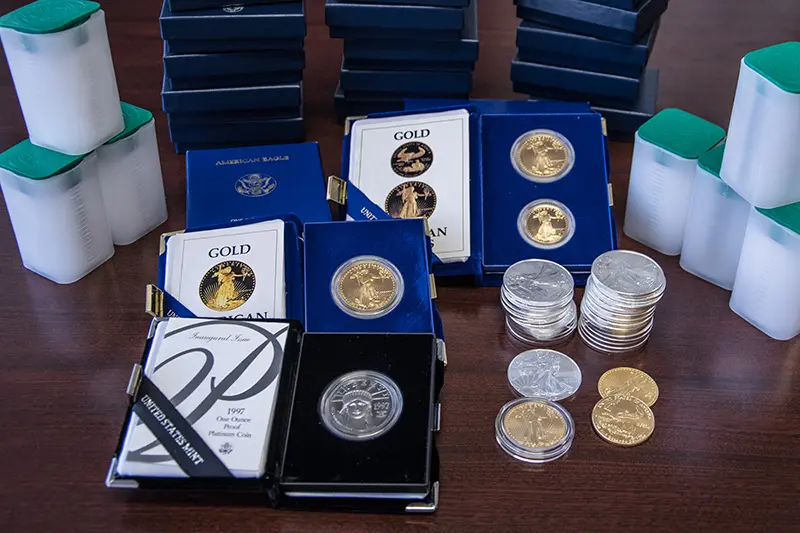
- American Gold Eagle (1 oz, 1/2 oz, 1/4 oz, 1/10 oz)
- American Gold Buffalo (1 oz, .9999 fine)
- Canadian Gold Maple Leaf (1 oz, .9999 fine)
- American Silver Eagle (1 oz, .999 fine)
- Canadian Silver Maple Leaf (1 oz, .9999 fine)
- PAMP Suisse gold bars (.9999 fine, assay card required)
- Credit Suisse gold bars (.9999 fine)
- Any gold bar from NYMEX/COMEX-approved refiner meeting .995+ purity
Numismatic Coins vs. Bullion
Numismatic coins derive value from rarity and collector demand, not metal content. They are not IRA-eligible. Common examples include pre-1933 gold coins, proof sets with limited mintage, and graded coins (MS-70, etc.). Some dealers push numismatic coins because they carry higher margins. A reputable precious metals IRA company sells only IRA-eligible bullion products and clearly distinguishes bullion from numismatic offerings.
Prohibited Transactions and Disqualified Persons
IRC Section 4975 defines prohibited transactions for IRAs. Disqualified persons include yourself, your spouse, your parents, your children, and any entity you control more than 50%. Prohibited transactions include: buying metals from or selling to a disqualified person; using IRA metals as collateral for a loan; storing IRA metals at home through a checkbook control LLC IRA or home storage IRA. The Tax Court ruled in McNulty v. Commissioner (2021) that a checkbook-control LLC used to store IRA-owned gold coins at the owner's residence triggered a full taxable distribution. UBIT (Unrelated Business Income Tax) may also apply if your self-directed IRA holds debt-financed property alongside precious metals.
If you engage in a prohibited transaction, the IRS treats your entire IRA as distributed on the first day of the year in which the violation occurred. The full value becomes taxable income, plus a 10% early withdrawal penalty if applicable. IRS Publication 590 provides detailed guidance on prohibited transactions.
Required Minimum Distributions (RMDs)
Traditional precious metals IRAs are subject to Required Minimum Distributions (RMDs) starting at age 73 under the SECURE 2.0 Act. You calculate your RMD based on the fair market value of your IRA as of December 31 of the prior year, divided by your life expectancy factor from IRS Uniform Lifetime Tables (Publication 590-B). RMD aggregation rules allow you to satisfy the combined RMD from all traditional IRAs by taking a larger distribution from one — so a gold IRA RMD may be satisfied from a companion traditional IRA holding liquid assets if you prefer not to liquidate metals at an unfavorable price. You can also satisfy a precious metals IRA RMD by taking an in-kind distribution of physical metals at appraised fair market value. Roth gold IRAs are exempt from RMDs during the owner's lifetime.
Your custodian reports the fair market value of your precious metals IRA on IRS Form 5498 annually. This form is also used to report rollovers and contributions. Ensure your custodian values metals at current spot price, not at the premium you originally paid.
How a Precious Metals IRA Works: Step-by-Step Process
Opening a precious metals IRA takes 1 to 3 weeks from start to funded account. Here is exactly what happens at each stage.
Step 1: Choose a Precious Metals IRA Company
Select a company based on fees, custodian partnerships, depository options, and customer reviews. Request a free gold IRA kit to compare. Your chosen company coordinates the entire process — they are the dealer, not the custodian.
Step 2: Open a Self-Directed IRA
Your company connects you with a self-directed IRA custodian (such as Equity Trust Company or STRATA Trust). You complete the IRA application — typically online in 10–15 minutes. The custodian establishes your account and assigns an account number.
Step 3: Fund Your Account via Rollover, Transfer, or Contribution
Fund the account through a direct rollover from a 401(k) or existing IRA (recommended), a custodian-to-custodian transfer, or a new cash contribution (subject to IRS annual limits of $7,000 for 2026, or $8,000 if age 50+). Direct rollovers complete in 5 to 15 business days.
Step 4: Select IRS-Approved Metals
Work with your dealer to choose gold, silver, platinum, or palladium products that meet IRS purity requirements. Your dealer provides current pricing including the premium over spot. You authorize the purchase through your custodian.
Step 5: Metals Ship to an IRS-Approved Depository
After purchase, your dealer ships the metals to your chosen depository (typically the Delaware Depository or Brinks Global Services). The depository verifies receipt, logs your holdings, and confirms storage to your custodian. You receive a confirmation statement listing each item by type, weight, and quantity.
Step 6: Ongoing Management and Distributions
Your custodian provides annual account statements and files IRS Form 5498. You can add metals at any time, sell holdings, or take distributions after age 59½. At distribution, you choose between an in-kind distribution (receive physical metals) or liquidation (receive cash). RMDs apply to traditional precious metals IRAs starting at age 73.
Gold IRA Custodians: Roles, Fees & How to Choose
Your self-directed IRA custodian is the legal entity that holds your IRA assets and ensures IRS compliance — choosing the right custodian affects your annual costs and the quality of your account administration.
What a Custodian Does
A self-directed IRA custodian holds legal title to your IRA assets, processes buy/sell transactions on your direction, files IRS Form 5498 annually, distributes Required Minimum Distributions, and coordinates with depositories for metal storage. The custodian does not provide investment advice — you make all investment decisions.
Equity Trust Company
Equity Trust Company is the largest self-directed IRA custodian in the U.S. with over $40 billion in assets under custody. They charge $75–$125/year for precious metals IRAs depending on account value. Augusta Precious Metals and Goldco both partner with Equity Trust as a primary custodian option. Equity Trust offers an online portal for viewing holdings, processing transactions, and downloading tax documents.
STRATA Trust Company
STRATA Trust (formerly Self-Directed IRA Services) charges a flat $95/year for precious metals IRA administration. They are based in Waco, TX, and specialize exclusively in self-directed retirement accounts. STRATA Trust processes rollovers within 3 to 5 business days and provides dedicated account managers for gold IRA clients.
Kingdom Trust
Kingdom Trust is a qualified custodian regulated by the South Dakota Division of Banking. They offer tiered pricing starting at $100/year for accounts under $100,000. Kingdom Trust supports a wide range of alternative assets beyond precious metals, making them suitable for investors who want to hold multiple alternative asset types in a single self-directed IRA.
How to Choose a Custodian
- Compare annual fees across custodians — differences of $25–50/year compound over time
- Verify the custodian is regulated by a state or federal banking authority
- Check whether the custodian offers an online portal for account management
- Ask about rollover processing time — faster custodians complete transfers in 3–5 business days
- Confirm the custodian works with your preferred depository (Delaware Depository, Brinks)
- Read custodian reviews on BBB and Trustpilot for complaints about responsiveness
Gold IRA vs. Traditional Retirement Accounts: Side-by-Side Comparison
A gold IRA costs more in annual fees than a standard IRA but provides physical-asset diversification that paper-only accounts cannot — the right allocation depends on your risk tolerance and retirement timeline.
Fee Comparison
- Traditional IRA (index fund): $0 setup, $0–$25/year expense ratio on $50,000
- Gold IRA: $50–$300 setup, $175–$600/year (custodian + storage) on $50,000
- 401(k): $0 setup, $50–$150/year in plan fees on $50,000
Asset Type and Liquidity
Traditional IRAs and 401(k)s hold paper assets — stocks, bonds, mutual funds — that trade instantly during market hours. Gold IRAs hold physical metals that require 1–3 business days to liquidate through your dealer. Gold ETFs (GLD, IAU) offer daily liquidity and expense ratios of 0.25–0.40%, but represent unallocated paper exposure to gold rather than ownership of allocated physical metal — ETF shares are backed by a trust that holds gold, not by metal assigned to your name. A precious metals IRA provides allocated, segregated ownership recorded in your name at an IRS-approved depository. Self-directed IRA custodians owe a fiduciary duty to follow your investment directions accurately and report account values correctly to the IRS, but they do not provide investment advice.
Tax Treatment
Traditional gold IRAs and traditional 401(k)s receive identical tax treatment: contributions may be tax-deductible, gains grow tax-deferred, and distributions are taxed as ordinary income. Roth gold IRAs work the same as Roth 401(k)s: contributions are after-tax, gains grow tax-free, and qualified distributions are tax-free. The IRS does not treat gold IRA distributions differently from other IRA distributions.
Portfolio Allocation Guidance
Most financial advisors recommend allocating 5–15% of retirement savings to precious metals. This allocation provides meaningful inflation protection and portfolio diversification without overconcentrating in a single asset class. Investors closer to retirement may favor a higher allocation (10–15%) for stability, while younger investors may prefer a lower allocation (5–10%) with more growth-oriented assets.
Our #1 Pick: Augusta Precious Metals — Why It Scored Highest
Augusta Precious Metals earned the top score in our evaluation because it combines the lowest total first-year cost with a lifetime buyback guarantee and the most transparent fee disclosure of any company we tested.
Fee Structure
Augusta charges $50 for account setup and $75–$125/year in custodian fees through Equity Trust Company. Storage at the Delaware Depository costs $100–$150/year for segregated storage. Total first-year cost on a $50,000 account: approximately $275. Augusta publishes all fees on its website — no hidden charges.
Buyback Guarantee
Augusta offers a lifetime buyback commitment on all metals purchased through them. When you are ready to sell — whether inside your IRA or after taking a distribution — Augusta repurchases at a competitive price based on current spot price. This eliminates the risk of being stuck with metals you cannot easily liquidate.
Custodian Partnerships
Augusta partners with Equity Trust Company (primary) and STRATA Trust Company (alternative) for custodial services. Both custodians are established, regulated entities with strong IRS compliance records. Augusta handles custodian coordination so you do not need to set up the relationship independently.
Customer Experience
Augusta assigns a dedicated account representative who stays with you for the life of your account. The onboarding process includes a one-on-one web conference covering gold IRA basics, fee breakdowns, and market context — with no sales pressure. Augusta holds an A+ BBB rating with zero complaints filed in the past 3 years.
401(k) Rollover Process
Augusta's team handles 401(k) rollover paperwork end-to-end. They contact your old plan administrator, prepare the rollover authorization forms, and track the transfer until funds arrive in your self-directed IRA. Average completion time: 7 to 10 business days for a direct rollover. Augusta processes over 2,000 rollovers per year.
What Could Be Better
Augusta's $50,000 minimum investment is higher than some competitors (Noble Gold starts at $20,000). Investors with smaller accounts may need to consider alternatives. Augusta also focuses primarily on gold and silver — their platinum and palladium selection is more limited than Birch Gold Group's.
Is a Precious Metals IRA Worth It? Pros, Cons & When It Makes Sense
A precious metals IRA is worth the higher fees for investors seeking inflation protection and portfolio diversification through physical gold and physical silver, but it is not optimal as a primary retirement vehicle due to zero yield and annual storage fees of $250–$400.
Pros of a Precious Metals IRA
- Inflation hedge — physical gold has maintained purchasing power over 20+ year horizons, outperforming paper assets during periods of economic uncertainty and economic downturns
- Tax-advantaged growth — traditional precious metals IRAs offer tax-deferred growth; Roth precious metals IRAs provide tax-free qualified distributions
- Portfolio diversification — precious metals have low correlation with stocks and bonds, reducing overall portfolio volatility
- Wealth preservation — gold and silver bullion serve as safe haven assets that retain value when fiat currencies decline
- Tangible asset ownership — unlike paper assets or gold ETFs, you own physical gold and physical silver stored in an IRS-approved vault
Cons of a Precious Metals IRA
- Higher fees — annual storage fees ($100–$300), custodian fees ($75–$300), and dealer premiums (2–8% over spot price) exceed standard IRA costs
- No dividends or interest — physical metals generate zero income; growth depends entirely on spot price appreciation
- Required Minimum Distributions (RMDs) — traditional precious metals IRAs require RMDs starting at age 73 under SECURE 2.0; satisfying RMDs may require liquidating metals at unfavorable prices
- Lower liquidity — selling physical metals takes 3–7 business days vs. instant trades in a standard brokerage IRA
- Home storage IRA and checkbook control LLC IRA schemes — storing IRA metals at home is illegal (McNulty v. Commissioner, 2021) and triggers a full taxable distribution plus 10% early withdrawal penalty
When a Precious Metals IRA Makes Sense
A self-directed IRA holding physical precious metals is most appropriate for investors with $50,000+ in retirement assets who want to allocate 5–15% to gold and silver bullion as an inflation hedge. It works best alongside a traditional IRA or Roth IRA holding stocks and bonds — not as a replacement. If your primary goal is wealth preservation during economic uncertainty rather than maximum growth, a precious metals IRA from a top-rated company like Augusta Precious Metals or Goldco provides the tax-advantaged structure to hold physical gold and silver long-term.
IRS-Approved Precious Metals: Eligible Coins & Bars for Your IRA
The IRS permits four metals in a self-directed IRA: gold (≥99.5%), silver (≥99.9%), platinum (≥99.95%), and palladium (≥99.95%) — numismatic or collectible coins do not qualify regardless of metal content.
Popular IRA-Eligible Gold Products
- American Gold Eagle (1 oz, 1/2 oz, 1/4 oz, 1/10 oz) — the only gold coin exempt from the 99.5% purity rule; authorized by Congress at 91.67% gold content
- American Gold Buffalo — .9999 fine (24 karat); the purest U.S. Mint gold bullion coin
- Canadian Gold Maple Leaf — .9999 fine; features micro-engraved security mark since 2014
- PAMP Suisse gold bars — .9999 fine; available in 1 oz, 10 oz, and kilo sizes from a COMEX-approved refiner
- Austrian Gold Philharmonic — .9999 fine; eligible for IRA inclusion
Popular IRA-Eligible Silver Products
- American Silver Eagle — .999 fine; the most widely traded silver bullion coin in the world
- Canadian Silver Maple Leaf — .9999 fine; higher purity than the minimum .999 requirement
- Silver bars (10 oz, 100 oz) from COMEX-approved refiners — lowest premiums over spot price for silver bullion
Important: numismatic coins — rare or collectible coins valued for their scarcity rather than metal content — are never IRA-eligible. Dealers who push numismatic coins into IRA accounts may be violating IRS rules. All five precious metals IRA companies in our rankings sell only IRA-eligible bullion products and disclose the premium over spot price on every purchase.
Sources & References
- Internal Revenue Code §408(m)(3) — Precious Metals IRA Exception to Collectibles Rule (irs.gov)
- IRS Publication 590-A: Contributions to Individual Retirement Arrangements (2025) (irs.gov/pub/irs-pdf/p590a.pdf)
- IRS Notice 2014-54 — Rollover of After-Tax Amounts from Retirement Plans
- SEC Office of Investor Education — Self-Directed IRA Investor Alert (sec.gov/investor)
- FINRA Investor Alert: Gold and Silver Coins — What Investors Need to Know (finra.org/investors/alerts)
- Better Business Bureau accreditation data for Augusta Precious Metals, Goldco, American Hartford Gold, Birch Gold Group, and Noble Gold Investments — accessed February 2026
- Equity Trust Company — IRS-approved nonbank custodian established 1974 (trustetc.com)
- Delaware Depository Service Company — COMEX/NYMEX-approved, insured by Lloyd’s of London (delawaredepository.com)


